


The Men of the 111th Go Back to War
Updated: Jun 25
Abstract:
Mentions of the111th New York Volunteer Infantry Regiment has they prepare for the Battle of Gettysburg, during the battle and the soliders lost after the fight
Photograph, 1864, Civil War photographs, 1861-1865, LC-B811-2709 [P&P], courtesy of the Library of Congress (https://www.loc.gov/item/2018666984/)
Original written by siblings George & Deb McGraw, August 2023. Revised and edited by Erika Newcombe and Deb Hall, June 2026.
The men of the 111th boarded a train Wednesday evening November 26, 1862 on their journey back into war. Earlier that week, they received notice that they had been “exchanged” for an equal number of Confederate prisoners, fulfilling their parole agreement. At this point, they only knew they were heading to Washington and shed no tears, leaving behind the poor food, large rats and infestation of lice at Camp Douglas.
These men who hailed from Wayne and Cayuga counties had just mustered in a few months earlier. After their first battle and subsequent surrender at Harper's Ferry, which led to their 2-month stay at Camp Douglas, they packed their belongings. The belongings included four days rations of beef, hardtack and soft bread for the train ride that would take them to Toledo, Cleveland, and Pittsburg. They arrived on Saturday in time for a good breakfast at the Pittsburg Refreshment Saloon and before reboarding the train, gave the ladies of Pittsburg three rousing cheers to which the ladies responded with shouts of “Pittsburg Welcomes her Country’s Defenders.”
Soon they were on another train for the long ride to Baltimore. They arrived in the evening where they had a good meal after only eating rations on the train. Leaving Baltimore later that evening, they rode overnight to Washington and reported that, “...we had poor cars and it was cold, and we of course had a rotten time.” Arriving at daybreak, they had to stay in the train cars until 9:00 a.m. breakfast before heading to their barracks.

Their first day in D.C. gave them an opportunity to see the Washington monument and the 15,000-pound bronze Statue of Freedom, also known as Armed Freedom, which was soon to be installed on the dome of the U. S. Capitol building.
On December 1st, the men left their barracks for a short march to Camp Chase, and on the 3rd, received Springfield rifled muskets but no ammunition. They were issued cartridge boxes with 18 rounds on the 7th when they were ready for armed picket duty. The men settled into camp life in their new Sibley tents in their new location which they named Camp Pomeroy, after their hometown Congressman from NY District 24.
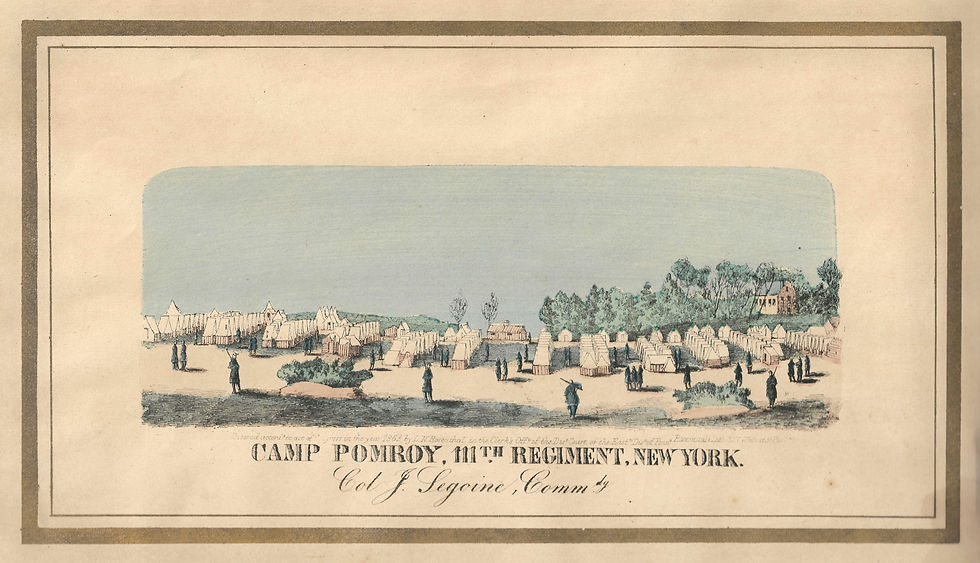
The days in Washington were a combination of drilling, dress parades, picket duty, and fatigue duty building a new fort nearby. They also spent time trying to keep warm while worrying about food. Foraging was a regular necessity, and one story from a Company K man tells of some men returning with a sheep that an officer quickly confiscated as being contraband—but it ended up in the officers’ mess. Several days later another carcass was confiscated, also with the same fate. However, after that incident, a howling “Bow, wow, wow” was often heard when an officer came by because the second carcass was a large Newfoundland dog.
Throughout December, the men moved to different camps in defense of Washington D.C. several times. They spent a few days in Fort Lyon before arriving at Camp Vermont, so named by the preceding regiment which was from the Green Mountain state. This camp consisted of stockades and space for tents. The stockades were described in letters home as being built of second growth trees split in two with the bark still on. A trench was dug and a post placed at each end, leaving space for a door. A small “A-frame” tent was then stretched over the posts, making a "comfortable little hog pen not quite as large as mine at home," one soldier said. There were bunks for four or five men and usually a small stove for warmth and cooking.
Cases of smallpox began to appear so the regiment could not move again until the disease was under control. Vaccinations began, along with complaints that the lice were a problem again. This was not unusual due to the lack of adequate washing facilities and other sanitary necessities in every camp.

However, it was not all doom and gloom. The men wrote home about the splendid view of Washington in the distance with Fairfax Seminary to the north and Alexandria just below. Passes were given out regularly so they could visit the nearby cities for food and necessities, providing they had money. Shoes were a constant topic since the Army-issued ones were of poor quality. New shoes in the city were $5, almost a half month’s pay, but shoe repair was only $1.50.
As the month progressed, the smallpox ran its course. The men also had their first exposure to Southerners who chewed tobacco. One letter described the habit in the following way. "They have a stick about the size of a pin holder that they dip into the box of snuff and then chew it, I think I would like to kick them in the mouth."
Some men received passes on December 27th to visit Alexandria, VA where they visited the Marshall House Inn.

A year earlier, on May 24, 1861, Major Elmer Ellsworth of the 11th NY Regiment became the first Union officer shot in the war. He was shot and killed by James Jackson, the proprietor of the Marshall House as he was removing a Confederate flag from the hotel’s roof. Ellsworth was a personal friend of President Lincoln. His death was avenged by 1st Lt. Francis Edwin Brownell of the same unit. Brownell was later given the Presidential Medal of Honor for this retribution.

On December 28th, there were reports of Confederate cavalry in the area so the men drew 80 rounds -- 40 in their cartridge boxes and 40 in their pocket -- and then marched 4 miles to support the pickets. The next day they alternated between sleeping on the ground and guard duty. Only two shots were fired. No one on either side was hit, and they never saw any cavalry.
Some of the men were on picket duty New Years Eve and were using the countersign of ‘Africa.’ While on duty, a 200-lb. pig came into view, and since it "did not give the appropriate countersign," it was shot dead by Billie Water of Company D.
The year 1862 ended with the men of the 111th still in defense of our nation’s Capitol, while the men of Company D enjoyed a "Christmas" dinner of fresh roasted pork, duck, chicken, baked and mashed potatoes, warm bread with butter and two kinds of cake. John Paylor of Company D recorded in his diary that he was promoted to Corporal and that the boys put on a dance and minstrel show that evening.
The facts of these stories have been discovered through the reading of Civil War diaries donated to historical societies and libraries by descendants and collectors. If the reader is a descendant of a Civil War soldier, especially those from Wayne County, please use the contact form to let us know about yourself and your ancestor. ###


Comments