


Defense of Washington, D.C. and the Journey to Gettysburg
Updated: Jun 29
Abstract: The men of the 111th New York Infantry spend months marching hundreds of miles with commentary on the soldiers' lives for over a year 1863-1864 including training, health and everyday life.
Original written by siblings George & Deb McGraw, August 2023. Revised and edited by Erika Newcombe and Deb Hall, June 2026.
In January of 1863, the men of the 111th were stationed at Camp Vermont near Alexandria, VA enjoying their New Years Day dinner. They would be leaving soon by train for Union Springs region, south of Centerville, VA. Once again they were uprooted from camp in order to move on with the war.

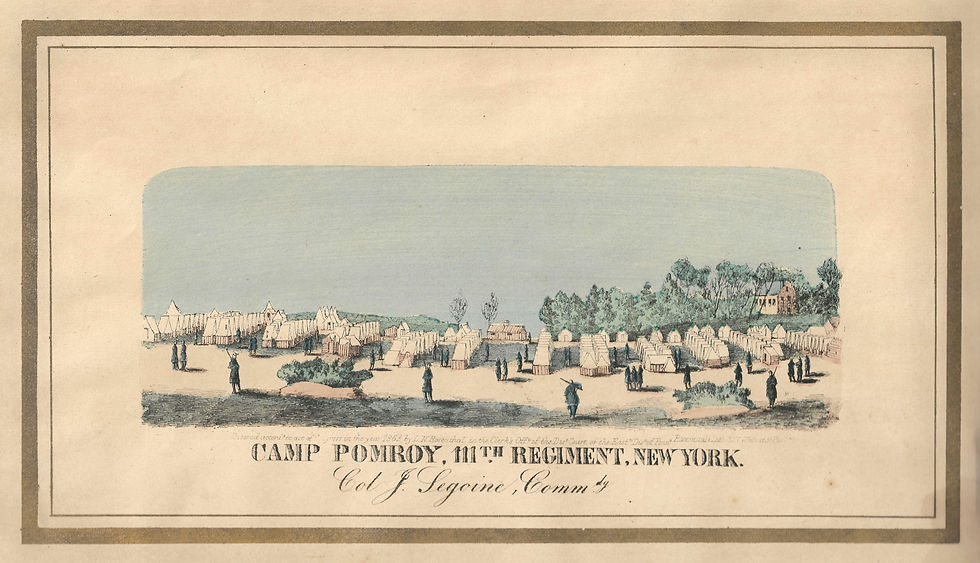
A short march took the men to an abandoned Confederate camp which was renamed Camp Hays in honor of their commander, General Alexander Hays. The men thought the new camp was not as nice as the one they left. Nearby Centerville was described as "a miserable, little, dirty, out of the way sort of place like Little Hollow or Lake Ridge."

Camp life restarted with the familiar routine of early roll call, then breakfast followed by inspections, drills and maybe some free time— then more drills. The companies would alternate pickets near the Bull Run Bridge.
January weather was a mixture of sunny days mixed with rain and sometimes snow. Night picket duty was not a pleasant experience especially since their rubber blankets made of a heavy canvas coated in vulcanized rubber, provided little protection in the sometimes ankle-deep mud.
On January 31, the men were blacking their boots, packing knapsacks and falling out at 11 a.m. with their white gloves on, ready for review by General Hays. On the first day of February, Lt. Samuel Bradley wrote in a letter home, “Our numbers are rapidly diminishing under our many labors and hardships, and this very day, out of the 1,040 noble men who marched through the streets of Auburn, in all the pride of vigorous manhood, there remains but little over 350 who are reported present for duty.”
The first week of February was the same routine of drills, poor food, no pay, inspections, guard duty and picket duty. On February 7, it was noted that those on picket duty used the countersign, Lexington. On the 22nd, the soldiers went about their routine in 4 inches of snow. Three days later on the 25th, the snow was over a foot deep. That evening there was "a great snowballing in which the right wing got whipped."
On the evening of March 1, the men from Company D heard the firing of muskets and cannon at nearby Union Mills while they were acting as reserve pickets. The long roll was beaten at camp while the men formed battle lines for two hours, but nothing happened. It was later reported that the ruckus was caused by bushwhackers. The rest of the month passed with only a few more false alarms.
On April 1, a Rebel sergeant passed through the regiment’s lines with the Rebel mail, using a pass from General Heintzelman. On April 2, Colonel MacDougall took the men out to fire off a dozen rounds and then practice an orderly retreat.

On January 21, they took part in a blackened boot and white glove review for General Abercrombie. The 39th, 125th, 126th, and 3rd Mass Battalions also participated. It was recorded that the 111th made a splendid show.
At the end of March 1863, President Lincoln had signed a resolution requesting a national day of fasting, prayer, and humiliation to seek forgiveness from God and prayers for the war effort. Lincoln's Proclamation 97 stated, "It behooves us, then, to humble ourselves …, to confess our national sins, and to pray for clemency and forgiveness … I do, by this my proclamation, designate and set apart Thursday, the 30th day of April, 1863, as a day of National Humiliation, Fasting and Prayer…”
On May 2, the men had target practice in the morning and Corporal John Paylor boasted that he fired six rounds at 101 yards, making the third best shot by hitting the target five times. The balance of the month consisted of drilling and picket duty at Washington Pike, Warrington Road and near the Warrington Railroad with no shots fired nor enemy seen.
By June 2, the men were ordered to strike camp and move about one-half mile where they set tents. Company B was sent out to scout. They reported seeing 2,000 Rebels who were likely commanded by Colonel Mosby, the Gray Ghost of Mosby’s Rangers.
When they returned on the 3rd, they brought in three Virginia cavalry men and two civilian prisoners. On the 9th, General Hays hosted a picnic and dance with, perhaps best of all, no dress parade. Soldiers were allowed to roam in more casual clothes for the event. On June 25, Lincoln replaced General Hooker with Major General George Meade as commander of volunteers of the Army of the Potomac. The 111th was then attached to the 3rd Brigade, 3rd Division, 2nd Corps with General Hays as brigade commander.
On June 24, the men received orders to draw 10 days rations and be ready to march to Thoroughfare Gap where the Battle of Chapman’s Mills had been fought in August 1862. Getting up at 4 a.m. on the 25th, they received shelter tents and left for Gum Springs at 2 p.m. They marched eight miles to Aldie, VA where they met the 2nd Corps, and marched 15 more miles before stopping.
On the 26th, they got up at 3:30 a.m. to eat breakfast and then started marching at 5 a.m., not knowing where they were headed. After halting for a 15-minute dinner break at 1 p.m., they continued on to nightfall and camped near Edward’s Ferry. On the 27th, Companies B and C were ordered back to the defense of Washington. They left the regiment, and would not return until March 1864.

The other Companies crossed the Potomac River into Maryland, marching through Poolesville and Branville, then another 15 muddy miles to Sugar Loaf Mountain where they camped for the night.
The men awoke before any sign of the sun at 3 a.m., struck tents and headed for Fredrick City. At 6 p.m., they arrived at Monocacy Junction and camped on the south side of the railroad where they had slept in the fall of 1862.
On June 29, they again were awake at 3 a.m. to march a grueling 94 miles with the whole Army of the Potomac through Knoxville, Libertyville, Middleberry and on to Uniontown. In the early dawn of June 30, they arrived with rain pattering against their uniforms and shoes soaked. The men mustered for pay at 3 p.m. and marched another mile before camping for the night. After that, the men who were prepared for battle amounted to less than the 470 who began the march in Virginia.
On July 1, the regiment had less than 350 men in fighting shape. They were detailed to guard the army’s supply wagons heading to Tarrytown. Reports soon came in that the Rebels were at nearby Gettysburg, so the supply train was ordered to the rear while the regiment was ordered to rejoin the Brigade and head to Gettysburg. The next two days would be fatal for some, valiant for others, and a turning point for the Union.

These stories have been researched and recalled here after reading both primary and secondary sources, such as Civil War diaries that have been donated to historical societies and libraries, by descendants and collectors. If the reader is a descendant of a Civil War soldier, especially those from Wayne County, New York, please use the contact form to let us know about yourself and your ancestor. ###

Comments