


Assault on Petersburg

Updated: Aug 31
Abstract: The Assault on Petersburg, also known as the Siege of Petersburg, was fought from June 1864-March 1865. The soldiers suffered from dysentery. Information on soldiers Thomas Geer and Dr. James D. Benton as well as others.
Originally written by siblings, George & Deb McGraw, November 2023. Revised and edited by Erika Newcombe, Deb Hall, and Oliver Groom, August 2026.
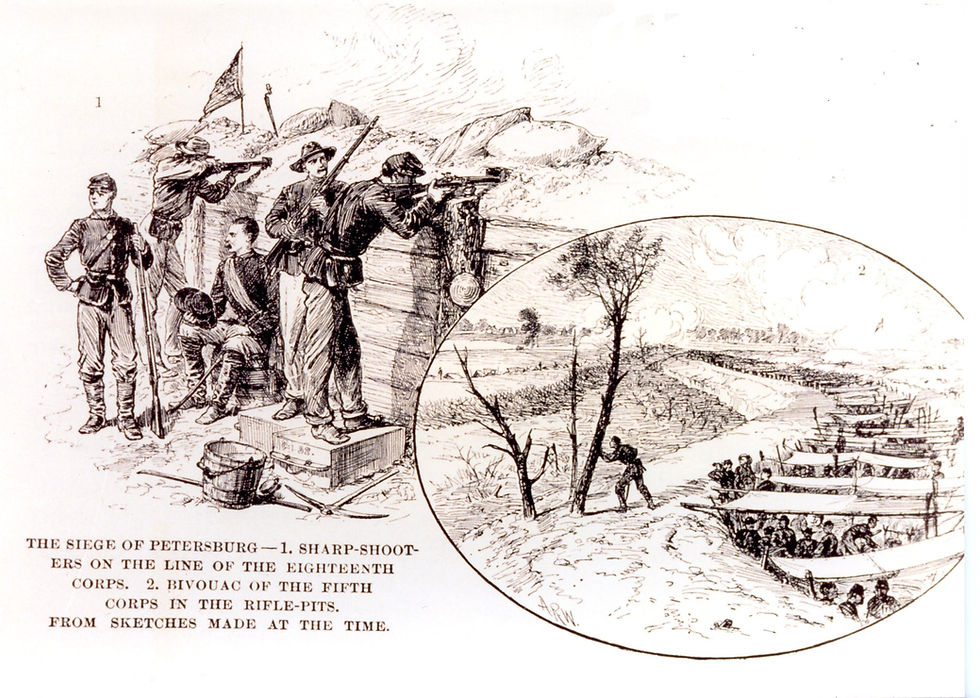
The assault on Petersburg, or more commonly known as the Siege of Petersburg, was fought from June 1864-March 1865. The campaign was not a typical siege in which the attacking army encircled the city and its defenders. Rather, it was nine months of trench warfare following Gen. Ulysses S. Grant’s two unsuccessful assaults on Petersburg. The Union Army of the Potomac’s thirty miles of trenches extended from the eastern outskirts of Richmond around the southern and eastern outskirts of Petersburg.


Cpl. Thomas Geer of Co. A wrote on June 23, “I am about played out this morning. We have had rough times lately. Out of seventy-six men we went in with we have got about forty-five left … no commissioned officers in the Company … I am the only noncommissioned … Our Regiment will be soon used up … I have got eight men present in the Company this morning.”
On the 26th, he wrote, “It is Sunday morning again and still the cannons roar. It seems as though they might keep quite Sundays … just seven o’clock and hot enough to boil our coffee in the Sun … There are ten men present in Company A this morning … Company D is the only Company in the Regiment that has a commissioned officer with it. Our killed and missing in Company A since we left camp number thirty-six … Our Division was forming a line in the woods. The trees were so thick we could not see far and the Rebs got us very nearly surrounded before we knew it. I tell you the way we got up and got out of the woods was a caution … only legs done their duty once.”
Over the bloody summer of 1864, the 111th had 95 officers and men present for duty in July, 86 in August, and 74 in September, in contrast to the 969 present for duty in 1862.
Assistant Surgeon Dr. James Benton of Co. D wrote on July 22, “Today has been remarkably quite on both sides once in a while we hear heavy guns booming … I can sit in the door of my tent and see the shells explode … in the night the long arch of the mortar shells go through the air like comets on a fandango … There is a rumor today that Grant has notified the Johnnies that Petersburg is in a state of siege and advised them to remove the woman and children to safety. The health of the Regt is usually good the principal difficulty being diarrhea.”

With research collected by Peter J. D'Onofrio, James Benton was a surgeon who worked skillfully at the following battles: Harper’s Ferry, Gettysburg, Cold Harbor, and the Siege of Petersburg. Dr. Benton also attended Abraham Lincoln’s second Inaugural Address and the capture of Richmond. James is buried at Union Hill Cemetery in Ira, Cayuga County, New York.
Cpl. Geer, suffering from chronic diarrhea, wrote on July 22 from a hospital, “… moved to City Point last Tuesday. I think I am a little better than I was when I came here but not much. Pete C. [Pvt. Peter Chasen, Co. A] is the only man here I know … he is gaining fast and will soon be back to the Regiment. There are a great many sick men here and some of them are very sick.”
Peter Chasen was transferred to the 4th U.S. Artillery in September 1864 where he served until the end of the war. Peter had enlisted in the war at the age of 32 and enlisted in Avon, New York, to serve for three years. On some records, his last name is spelled, “Chassen.”
Geer was moved between hospitals, eventually at Sisters Hospital in Buffalo, where on October 18 he wrote, “I leave for the front this afternoon … there are seven of us … it is a mighty cold day to travel without an overcoat … I think I shall get to the Regiment sometime next week.”
Geer, now a sergeant, returned to the regiment in early November and on the 11th he wrote, “We are lying about 3 miles from Petersburg … can see the city from our camp. We are about ½ mile from the front line or picket line. Picket firing is kept lively most of the time and considerable cannonading nights … We have got a mighty green set of men in Company A … We are all very anxious to hear from elections. There will be lively times when we do hear. If Lincoln is elected on our side we will open the ball by firing a salute. If McClellan is elected the Johns will open.”
President Lincoln, who was commonly referred to as “Father Abraham” in the Union Army, made arrangements for most of the men to vote while in the field or hospital.
Diarrhea and dysentery (diarrhea with blood in the stool) were the foremost killers during the war, with 57,000 deaths directly attributed to them. The 111th lost at least six recorded deaths to these disabling maladies. Countless men from the regiment lost weeks and sometimes months suffering in hospitals, and many were discharged for disability after the diseases had wracked their bodies. Crowded conditions, poor hygiene, absence of sanitary disposal of garbage and human waste, inadequate diets, and no specific disease treatments were a formula for disaster. Total reported sick cases for all diseases were over 5.8 million, of which dysentery and diarrhea accounted for 1.5 million.
While the regiment continued their efforts at the siege in Virginia, Sgt. Hutchins of Co. D wrote in his diary on July 11 from Andersonville: “There were six raiders [raiders were rogue prisoners who stole from others] hung today they received their just reward, I am 25 years old today where will I be in another year May Providence guide, guard and direct me further.”
On July 12, he wrote, “warm & pleasant day light clouds flew over & by & helped greatly cooling the air I felt a little down hearted & took a nap I went to draw rations William York, B Williams & John Almakinders came in as prisoners of War, Bad Place for any animal.”
Cpl. William York of Co. D was wounded on the third day of Gettysburg in July 1863 before being captured on June 21, 1864, at Petersburg; there are no further records of what happened to him. Alexander B. Williams, 2d, of Co. D joined as a private in 1862, was wounded at Bristoe Station in October 1863, promoted to corporal April 1864, and then promoted again to sergeant before his capture on June 22 at Petersburg.
William died as a captive on September 17, 1864, receiving a posthumous promotion to second lieutenant.
John Almakinders of Co. D was wounded at Gettysburg before his capture on June 21, 1864; he died a POW. He had enlisted on August 7, 1862, at Sodus to serve for three years and was mustered in as a private in Co. D on August 20, 1862. His burial location remains unknown as of August 2026.
The Siege of Petersburg continued through the winter and into the early spring of 1865.
The Wayne County Historical Society encourages anyone with family members who served and lived in Wayne or Cayuga Counties during the 1860s to contact the Wayne County Historical Society at info@waynehistory.org or (315) 946-4943. If you are not sure about your Civil War ancestry, you can follow up with the link below:
Photos:
“The Federal Army Entrenched Before Petersburg - A Night Scene in the Trenches.” By Edwin Forbes
Thomas Geer (Photo uploaded to findagrave by LCTR).
Dr. James D. Benton (Photo from New York State Military Museum and Veterans Research Center)
“Sharpshooters on the line of the Eighteenth Corps” created by Alfred Robert Waud.
Sources:
Find a Grave. “James Dana Benton.” Find a Grave Memorial, Memorial no. 21733259. Accessed July 8, 2026. https://www.findagrave.com/memorial/21733259/james_dana-benton
D'Onofrio, Peter J. (2018). “Death, Disease, and Life at War: The Civil War Letters of Surgeon James D. Benton, 111th and 98th New York Infantry Regiments, 1862-1865,” Civil War Book Review: Vol. 20 : Iss. 4. https://repository.lsu.edu/cgi/viewcontent.cgi?article=3369&context=cwbr
New York State Division of Military and Naval Affairs, One Hundred and Eleventh Infantry, in Annual Report of the Adjutant-General of the State of New York for the Year 1900: Registers of the One Hundred and Eleventh Infantry, accessed July 2, 2026, “111th Infantry Civil War Roster.”
Wayne Historians Organization. Wayne County Civil War Soldiers. Accessed July 2, 2026. “Wayne County Civil War Soldiers.”


Comments